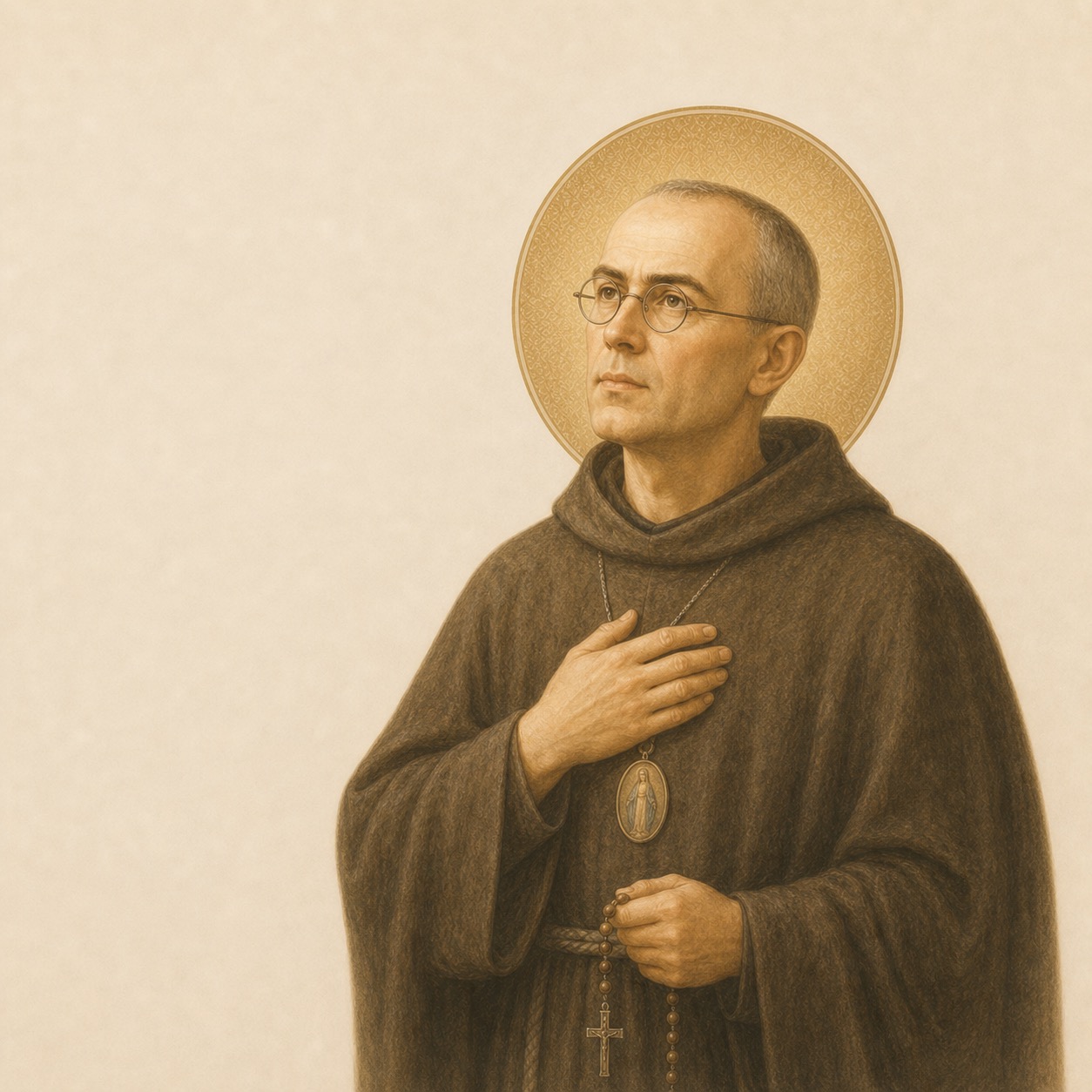
St. Maximilian Kolbe
Priest and Martyr
1894–1941
A Polish Conventual Franciscan with a passionate devotion to Mary, founder of a friary outside Warsaw and a missionary house in Nagasaki. After the Nazi invasion of Poland he sheltered thousands of refugees, including 2,000 Jews, in his friary. Arrested in 1941 and sent to Auschwitz, he stepped forward to take the place of a married man chosen for the starvation bunker, and died there of a lethal injection on the eve of the Assumption.
Born Rajmund Kolbe near Lodz, he joined the Conventual Franciscans at sixteen and studied in Rome, where he founded the Militia Immaculatae in 1917 to combat religious indifference through Marian consecration. Returning to Poland, he established Niepokalanow — the "City of the Immaculate" — which by the late 1930s housed over 700 friars and published a daily newspaper reaching a circulation of 230,000.
In the starvation bunker of Auschwitz, Kolbe led the condemned men in hymns and prayers for two weeks until only he remained alive, at which point the guards administered a lethal injection of carbolic acid. He was canonized by Pope John Paul II in 1982 as a "martyr of charity." Franciszek Gajowniczek, the man whose place Kolbe took, attended the ceremony and lived to the age of ninety-three.
Sources

Metanoia
A quiet daily companion that takes today's Mass readings and reflects them back through what you're actually living.