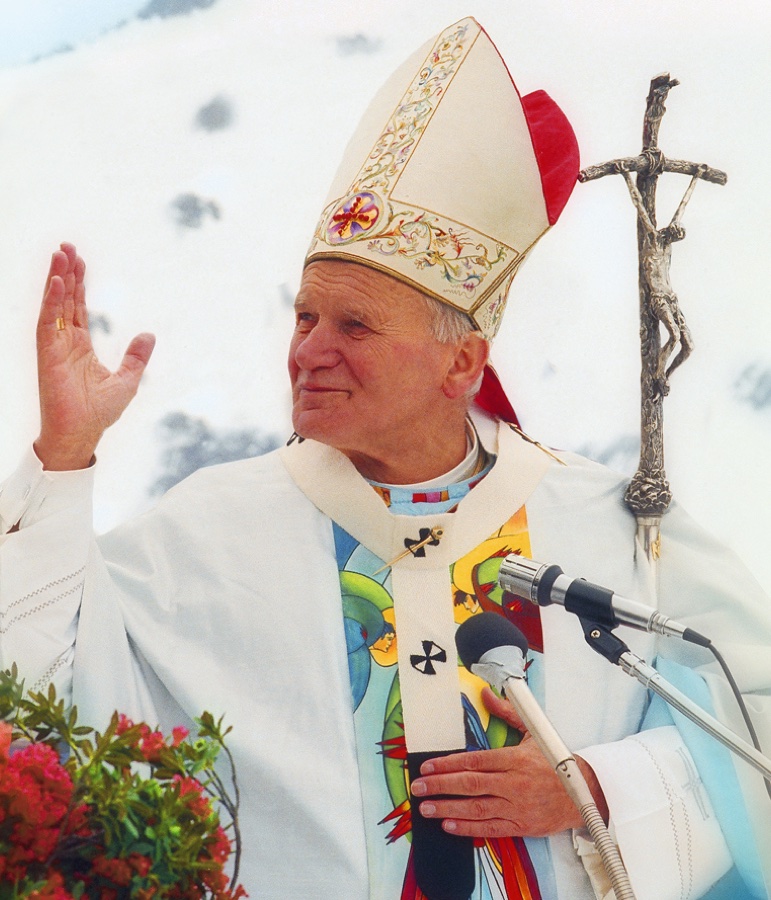
Pope St. John Paul II
Pope, Pilgrim of Peace
1920–2005
Karol Wojtyła, born in occupied Poland, was a young actor, quarryman, and clandestine seminarian under the Nazi occupation. As Archbishop of Krakow he stood up to the communist regime; as pope from 1978 to 2005 he became the first Slavic pope, traveled to over 130 countries, and helped peacefully topple the Iron Curtain. He survived an assassin's bullet in 1981 and embraced his shooter in his prison cell two years later.
His pontificate reshaped the modern papacy. He inaugurated World Youth Day, published the Catechism of the Catholic Church, and produced a vast body of encyclicals and apostolic letters — from Redemptor Hominis to Fides et Ratio — that engaged the modern world with philosophical depth and pastoral warmth. His Theology of the Body offered a profound vision of human love rooted in the mystery of creation.
He died on April 2, 2005, as the crowds in St. Peter's Square kept vigil and the world watched. "Do not be afraid" had been the motto of his pontificate, drawn from the words of Christ, and he lived it to the end — governing through Parkinson's disease, refusing to hide his suffering, teaching by his dying that every human life has dignity to its last breath. He was canonized in 2014.
Sources
Gregorini Demetrio, c. 1988 — CC BY-SA 3.0 · Wikimedia Commons
Metanoia
A quiet daily companion that takes today's Mass readings and reflects them back through what you're actually living.