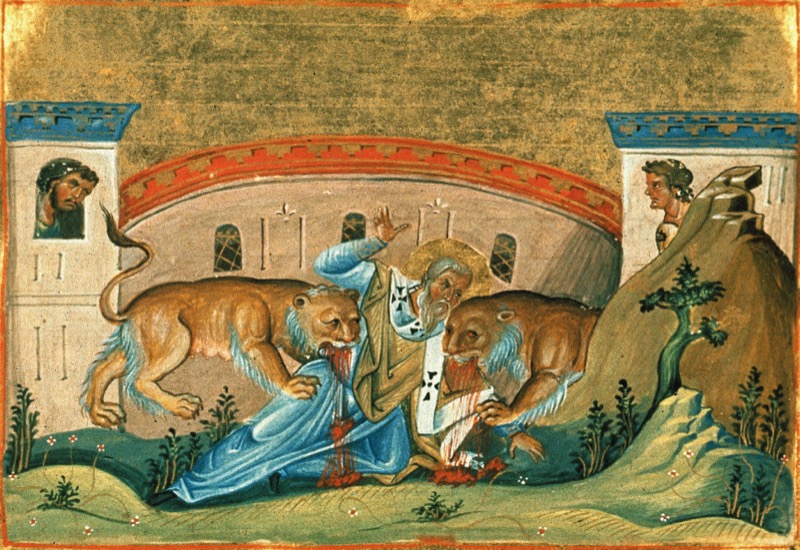
St. Ignatius of Antioch
Bishop and Martyr
c. 35–c. 108
The third bishop of Antioch, condemned to be torn apart by wild beasts in the Roman Colosseum under Trajan. On the long journey to his death he wrote seven letters to the churches he passed — letters that are our earliest witnesses to the threefold ministry of bishop, priest, and deacon, and to the Eucharist as "the medicine of immortality." "I am the wheat of God," he wrote, "to be ground by the teeth of beasts that I may become Christ's pure bread."
According to tradition, Ignatius was a disciple who had known the apostles themselves — possibly the very child whom Christ set in the midst of his disciples as a sign of the kingdom. His letters burn with a longing for union with Christ so intense that he begged the Roman Christians not to intervene to save his life, lest they rob him of his crown.
He was martyred in the arena around the year 108, and his relics were carried back to Antioch by his companions. His writings remain a cornerstone of early Christian theology — a witness to the unity of the Church, the reality of Christ's flesh, and the conviction that the path to God passes through the breaking of one's own body in love.
Sources
Menologion of Basil II, c. 10th century — public domain · Wikimedia Commons

Metanoia
A quiet daily companion that takes today's Mass readings and reflects them back through what you're actually living.